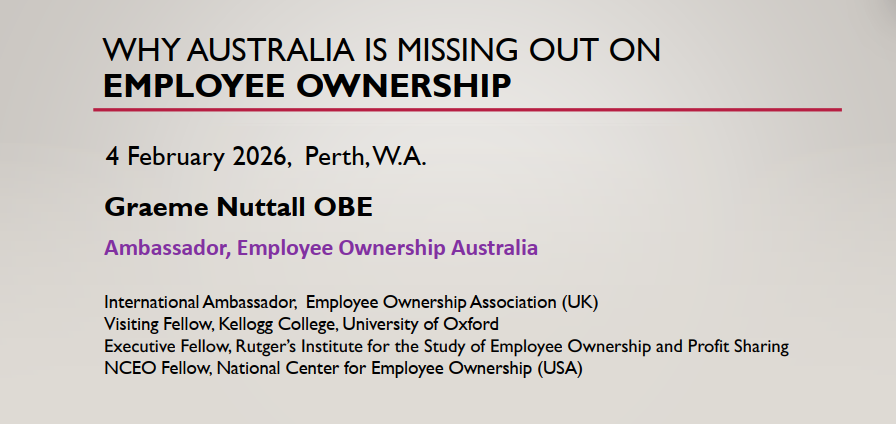
The recent Employee Ownership Australia (EOA) roundtable held on 4 February 2026, “Why is Australia Missing Out on the Employee Ownership Success Story?”, featured Graeme Nuttall OBE, international authority on employee ownership and architect of the UK’s successful policy framework. The event was hosted by EOA with the law firm, King & Wood Mallesons. There was an option to attend remotely, with a recording of the event now available.
At the event, Graeme provided a comprehensive overview of the rapid growth of employee ownership legislation globally and the transformative role of Employee Ownership Trusts (EOTs) in several economies. The session also explored the structural and regulatory barriers currently limiting development in Australia, alongside practical insights from Australian EOTs, Your New Dentist (Melbourne) and Strategic Development Group (Yass, NSW), which shared their real-world experiences.
If you missed the live session, you can watch the full recording here: https://youtu.be/2fZWa1qlhwQ?si=TwpWCZ-KOHdbGJ8U.
You can also check out the slides from the event ‘here’.
The event was a provocative and insightful conversation exploring:
- Why Australia might be “missing out” on global employee ownership trends, particularly models like EOTs widely used overseas.
- Global lessons from jurisdictions, including the UK, where employee ownership is more established, and how those lessons could apply in Australia.
- The potential role of employee ownership and EOTs in business succession, SMEs, productivity, and shared economic participation.
A petition (EN7712) is also currently before the Australian House of Representatives and this is urging the Treasury to establish tax guidelines and legislation to support EOTs. It is argued that EOTs boost productivity and facilitate business succession, urging Australia to adopt this model, which is already successful in the UK.
Key details about the petition are:
- Purpose: The petition seeks to create specific tax incentives and, crucially, clear guidelines for the establishment of EOTs, which hold company equity on behalf of employees.
- Benefits: Proponents claim EOTs offer a “no-brainer” solution to succession challenges for SMEs, retaining local jobs, preserving company culture, and increasing employee engagement.
- Current Status: While the government has shown sympathy toward employee ownership, formal legislation for specific, UK-style EOT tax advantages is not yet in place.
- Industry Support: EOA is actively pushing for these reforms, arguing that without them, Australia risks missing out on a global trend in corporate ownership.
The petition highlights that Clear Tax Guidelines for EOTs are essential to prevent confusion and encourage adoption.
In the international context — particularly the UK — where Nuttall’s work has shaped employee ownership policy through EOTs, the outcome has been significant legislative change and thousands of businesses adopting employee ownership models since the UK’s Finance Act 2014.
Australia is missing out on these global employee ownership (EO) trends due to a complex, restrictive regulatory environment and, until recently, a lack of tax-advantaged structures like EOTs. While nations like the UK and USA promote broad-based share ownership, Australia’s high compliance costs, demanding disclosure requirements, and slow adoption of succession-focused EOTs create barriers.
Key Factors for Australia’s Lagging Employee Ownership are :
- Regulatory Hurdles and Compliance Costs: Australian regulations for offering shares, particularly for private companies, are often seen as overly burdensome, requiring complex prospectuses and hindering widespread adoption compared to international counterparts.
- Tax and Structural Complexity: The tax, legal, and financial structuring of employee share schemes in Australia can be complex, making it difficult for SMEs to implement, unlike the more streamlined EOT models gaining popularity elsewhere.
- Low Awareness and Adoption of EOTs: While EOA is promoting EOTs as a succession solution for retiring business owners, the model is not as widely understood or supported by public policy as in the UK.
- Risk Aversion and Capital Limitations: The high cost of funding and liquidity challenges for purchasing shares from departing employees can discourage companies from establishing share ownership programs.
- Cultural Focus: There has been an historical preference for traditional ownership models, leaving Australian employees less involved in business ownership compared to global trends.
To keep pace, advocates are arguing Australia needs to streamline regulations, provide clearer guidance, and encourage the use of EOTs to foster better employee engagement and productivity.